
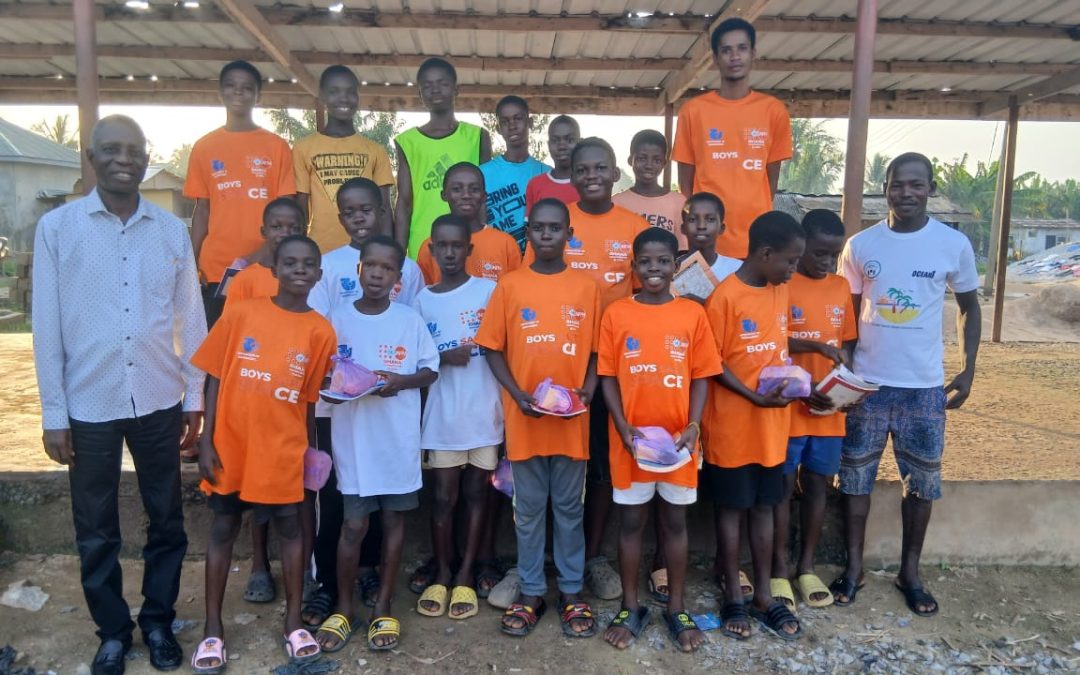
 Central Regional Co-ordinating Council (CRCC) embarked on joint -monitoring exercise to the various communities where second quarter activities for 2026 were implemented to assess the impact of the programmes on beneficial communities and on individuals. The exercise commenced on Tuesday 9th -12 May 2026 owing to reschedule of engagements by beneficiaries.
The exercise was undertaken by the CRCC Focal Person, David Allan Painstil and Peter Effah Otoo, Information Technology Officer. In all 65 beneficiaries aged between 11 and 50 years were interviewed. This number was made up of 45 males and 20 females. The team visited Brabadze community in the Cape Coast North Constituency where Department of Gender (DOG) held Boys Safe Space activity there to sensitize the adolescent on child marriage, sexual and gender-based violence, domestic violence, harmful cultural practices and personal hygiene.
In addition, the team visited Cape Coast School for the Deaf and Blind to interact with them regarding minimum essential package, thus violence against women and girls. The team further interacted with the traditional leaders who benefitted from Department of Gender follow-up engagement with Traditional Authorities at Emintsimadze Palace in Cape Coast.
Again, some of the beneficiaries of the Coordination Meeting were also interviewed to know their understanding of the meeting regarding United Nations Population Fund (UNFPA) supported activities in the region.
On Boys Safe Space activity which was organised by the Department of Gender at Brabadze, a rural community in the Cape Coast Metropolis, 25 adolescent boys were engaged during the monitoring. The programme has transformed them with majority of them acknowledging the fact that they have stopped smoking, pre-marital sex, truancy and disrespect towards their parents and guardians. For instance, Richard Paintsil 18, who said he dropped out of school because of substance abuse and pre-marital sex has returned to school and now in Form 3 at Jukwa Senior High School. Additionally, Joseph N. Mensah, 11, said he was into unnecessary fighting and alcoholism but now he has stopped paying more attention to his studies.
Regarding Minimum Essential Package which was held at the Cape Coast School for the Deaf and Blind, 35 students comprising 19 males and 16 females were interviewed through sign language method by their teachers. Before the interview, their teachers reminded them about the programme and the topics that were treated. Most of them said the issue of domestic violence, sexual and gender-based violence citing rape and defilement as best topics that would help shape their future. They also expressed gratitude to the Regional Coordinator of the Domestic Violence Victim Support Unit (DOVVSU) Mr John Asare Bediako who urged them to report any sexual and gender-based violence issue to his office in Cape Coast. For example, Winifred Donkor, 17 years said, the programme opened her mind to be careful with males who come to her way. She therefore appealed for continuous engagements with the school on matters regarding domestic violence, child marriage and parental neglect.
According to School Health Education Programme (SHEP) Coordinator at Cape Deaf, Mrs Rose Adido, 50 teachers who are currently teaching in the school all attended Cape Deaf and later continued to the University of Cape Coast for their various degree programmes. She thanked UNFPA for its continuous engagement with the students and urged UNFPA to sustain the partnership between the two institutions.
On Follow-up of the Traditional Authorities activity, Nana Banyin Amoah, Mankrado of the Oguaa Traditional Area maintained that he has come to realisation that child marriage, adolescent pregnancy and harmful cultural practices, and sexual and gender-based violence retard progress of the society He said because of the programme he had gained knowledge to transform his community. He added that after the programme, he has counselled 10 boys and six (6) adolescent girls from social vices such smoking, unsafe sex, loitering round in the night. For her part, Nana Akuokuta III, Queen mother of Abura, a suburb of Cape Coast explained that she adopted a strategy of using cultural troop activity as a platform to sensitize adolescents on the need to avoid unsafe sex, cohabitation, sexual and gender-based violence and as well as hygiene.
She counted 12 girls and 15 boys aged between 12 and 17 years who have benefitted from the knowledge she acquired during Department of Gender’s programme. Nana Anafo IX, Chief of Nkanfoa said the programme organised by the Department of Gender has created awareness among the Chiefs especially, laws regarding sexual and gender-based violence, child marriage and harmful cultural practices. She indicated that the punishments associated with defilement, rape and incest have put fear in the people in his community and urged Department of gender to continue with the good work in the region.

