
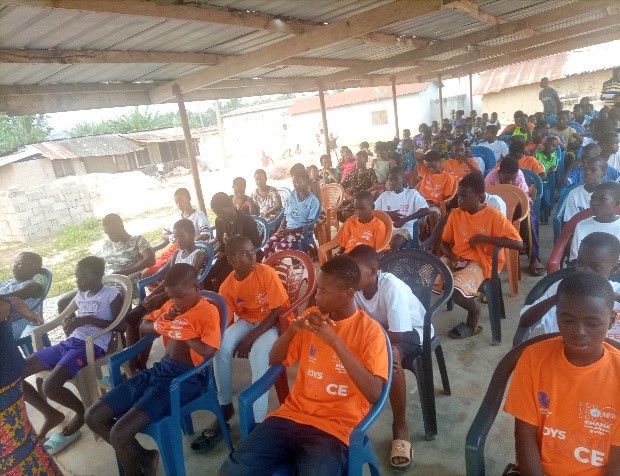
The quarterly follow-up session with the community’s Boys’ Safe Spaces was organised by the Department of Gender, under the Ministry of Gender, Children and Social Protection, in collaboration with the Central Regional Coordinating Council (CRCC) and with support from UNFPA.
Why boys, and why now
Sexual and Gender-Based Violence (SGBV) and challenges in Adolescent Sexual and Reproductive Health and Rights (ASRHR) continue to affect the well-being, education and development of young people in the Central Region. Recent engagements with parents and traditional leaders pointed to the persistence of SGBV, early marriage, harmful cultural practices and other forms of gender inequality in communities.
The organisers’ answer is that lasting change needs both women and men. Boys and young men, in particular, can be advocates for positive change among their peers, families and neighbours. The session aimed to build a network of Male Champions committed to ending harmful practices and SGBV, to equip them as peer mentors for gender equality and sexual and reproductive health and rights (SRHR), and to give them the skills to challenge and report abuse.
A full room, with parents’ backing
The programme brought together 54 boys aged 10 to 19 and 47 girls aged 9 to 19, alongside community facilitators, resource persons, staff of the Department of Gender and media representatives. Although the sessions were designed for boys, parents and guardians consented to their daughters and wards taking part, a gesture of community support that made the discussions more inclusive.
What the young people learned
The opening session featured remarks from Richlove Amamoo (Mama Awotsu Adzagba II), representing the Department of Gender, Central Region, who stressed why men and boys must be involved in tackling SGBV and promoting ASRHR.
Facilitators then led interactive sessions on gender equality, SGBV, child marriage and harmful cultural practices. They explained how these issues affect adolescents’ health, education and development, and what the law says. Participants learned about the legal consequences of offences such as defilement, rape and child marriage under Ghanaian law.
Other topics included:
- Responsible decision-making and rights. Sessions on SRHR emphasised respect for human rights and the dignity of women and girls.
- Health. Awareness was raised on HIV, Hepatitis B, teenage pregnancy and personal hygiene.
- Drug abuse, violence and mental health. A mental health nurse from the Effutu Health Centre, Ms. Millicent Nkansah, spoke on drug abuse and violence, and on how they affect mental health and academic performance.
- Staying focused. Adolescents were encouraged to hold on to their education and career aspirations.
Learning by doing
The organisers deliberately avoided lecture-only teaching. The day combined presentations with group work, peer learning, role plays and scenario-based exercises that simulated real-life situations. Question-and-answer sessions cleared up misconceptions, and plenary discussions pulled the key messages together. Real-life case studies and practical examples helped the lessons land.
Participants also took part in advocacy and communication training, designed to help them talk with peers, parents and community leaders about GBV, child marriage and gender equality. Male Champions were introduced to their roles as peer educators and community advocates, with a focus on positive masculinity and being role models for other young people.
Results
Facilitators reported active, sustained engagement throughout the programme, and a notable improvement in participants’ awareness of the dangers of drug abuse and risky sexual behaviour. By the end of the day:
- Participants showed better understanding of key concepts during discussions and the open forum.
- They reported more confidence to report incidents of abuse to the appropriate authorities.
- Collaboration between the Department of Gender, health professionals and the young participants was strengthened.
Challenges
Not everything was easy. Some participants had limited prior knowledge of legal and mental health issues, which called for extra explanation. Others were shy about openly discussing sensitive topics such as sexuality and abuse. Organisers also noted that the lack of visible corporate role models in the community can weigh on young people’s motivation and aspirations.
Lessons for similar programmes
- Make it participatory. Adolescents engage most when sessions are interactive.
- Keep the conversation going. Continuous sensitisation on SGBV, child protection and drug abuse is needed to reinforce behaviour change.
- Teach early. Early education on legal consequences and reproductive health helps young people make informed choices.
- Talk about mental health. Mental health education reduces stigma and promotes healthy lifestyles.
- Work across institutions. Partnerships between gender departments, health facilities and schools make sensitisation more effective.
The road ahead
The organisers say the programme met its objectives and has laid a strong foundation for sustained community sensitisation and behaviour change. With Male Champions now in place in Brabedzi, participants have committed to acting as agents of change by promoting gender equality, protecting the rights of women and girls, and working to end SGBV and child marriage in their communities.
The activity was organised by the Department of Gender and the Central Regional Coordinating Council, with support from UNFPA.