
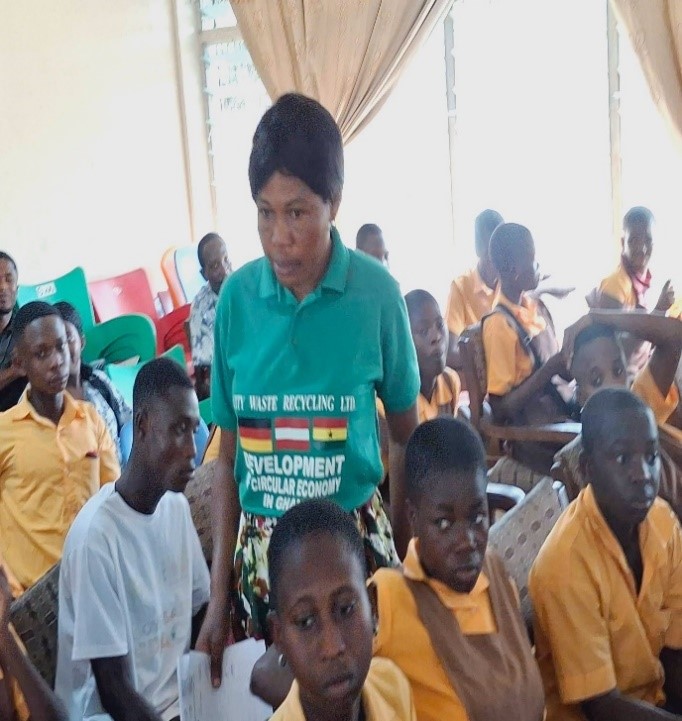
For students who are deaf or blind, knowing where to report abuse and how to get help can be harder than it should be. On 30 April 2026, a team of service providers took that information to them. The Department of Gender, Central Region, working with the Central Regional Coordinating Council (CRCC) and with support from UNFPA, brought a mobile outreach on Gender-Based Violence (GBV) and essential services to the Cape Coast School for the Deaf and Blind.
Why it matters
Sexual and Gender-Based Violence (SGBV), including domestic violence, remains one of the most widespread human rights violations in the world. Survivors can face serious physical injury, psychological trauma, reproductive health complications, economic hardship and social exclusion.
The outreach was built around the Essential Services Package (ESP): the core elements of a coordinated, survivor-centred response to violence against women and girls, covering health, police, justice and social services. When these services work together, survivors recover faster, are better protected and are more likely to see justice done. The activity also supports Sustainable Development Goals 5 (gender equality) and 16 (peaceful, just and inclusive societies), and UN Security Council Resolution 1325 on Women, Peace and Security.
The aim of the day was to make sure persons with disabilities are not left out of that system. It focused on raising awareness of GBV and the services available, explaining its forms, causes and consequences, showing students how to report abuse and where referrals lead, and building their confidence to speak up and seek help.
Who was in the room
Thirty stakeholders aged 25 to 50 joined the programme, representing the institutions that prevent and respond to GBV. They came from the Department of Gender and CRCC, the Judicial Service, the Domestic Violence and Victim Support Unit (DOVVSU) of the Ghana Police Service, the Legal Aid Commission, the Ghana Health Service, the Ghana Education Service, the Commission on Human Rights and Administrative Justice (CHRAJ), the National Youth Authority, the Department of Social Welfare and the National Peace Council, among others.
They met 88 students with disabilities, 57 boys and 31 girls, all aged 10 to 19.
Making the information accessible
The organisers designed the session around the students’ needs. Sign language interpretation was used throughout, alongside demonstrations of reporting procedures and referral pathways, question-and-answer sessions, group discussions and real-life case studies. Information, Education and Communication (IEC) materials were handed out so students could keep the key messages after the day ended.
What the speakers said
Technology and abuse. Ms. Richlove Amamoo (Mama Awotsu Adzagba II), the Central Regional Head of the Department of Gender, drew attention to Technology-Facilitated Gender-Based Violence (TFGBV). She voiced concern about mobile phones and social media being misused to exploit young people, noting that some abusers take advantage of trust, record private moments and later use them for blackmail. She also covered cyberbullying, cyberstalking, online sexual exploitation, non-consensual sharing of intimate images and impersonation, and offered practical steps for staying safe online and reporting incidents.
Abuse close to home. Mrs. Rosemond Yeboah-Sarpong of the Ghana Health Service noted that many abuse cases happen in familiar environments and sometimes involve relatives.
Progress on teenage pregnancy. David Allan Paintsil, UNFPA focal person at the CRCC, highlighted the region’s progress. The Central Region, which once ranked first in the country for teenage pregnancy, has now dropped to 12th position.
Boys are victims too. The DOVVSU Coordinator of the Ghana Police Service stressed that sexual abuse is not limited to girls. “Boys are also victims, but many do not speak up,” he said. He assured the students that all cases are handled with strict confidentiality and that victims’ identities are protected throughout investigations and court proceedings.
Justice. Ms. Phyllis Quartey of the Judicial Service said the courts remain committed to prosecuting offenders, especially in defilement cases. Students were also encouraged to make use of government apprenticeship and skills development programmes to build their futures.
Students raise real barriers
The students did not only listen. They told the panel about obstacles they face when seeking justice and care. These included the lack of sign language interpretation in courts, which makes reporting difficult. Others spoke of challenges at health facilities after incidents of abuse, and of third parties being involved in the reporting process. Stakeholders acknowledged the need for service delivery that is accessible, responsive and tailored to persons with disabilities.
Beyond the talks
Members of the ESP Committee also presented examination materials to final-year students, a gesture meant to show that the Committee cares about both academic achievement and student wellbeing.
What was achieved
- Students showed better understanding of SGBV, adolescent sexual and reproductive health and human rights.
- They became more familiar with reporting channels and support services, including DOVVSU, CHRAJ, the Legal Aid Commission and the Ghana Health Service.
- Partnerships between the service providers and the school community were strengthened.
- Participants were encouraged to speak up against abuse and discrimination, and to support peers who may be at risk.
Challenges and lessons
Communication barriers remained a challenge, particularly for deaf participants, even with interpretation in place. The organisers say this points to the need for consistent sign language interpretation, visual aids and other accessible learning materials in future outreach.
Other lessons from the day:
- Collaboration works. Coordinated action among institutions makes survivor-centred support faster and more effective.
- Report early. Early reporting improves survivors’ access to justice, healthcare and psychosocial support.
- Keep educating. Continuous sensitisation is essential on SGBV and adolescent pregnancy, especially among persons with disabilities.
- Address digital abuse. Public awareness of technology-facilitated violence needs to grow.
- Include everyone. Education institutions, service providers and communities must work together to sustain prevention.
The way forward
The outreach brought key institutions to the students’ own school and left them with a clearer understanding of their rights, the support available and why reporting matters. For the organisers, it reflects a shared commitment to safeguarding the welfare of adolescents, particularly those living with disabilities, in the Central Region.
The activity was organised by the Department of Gender, Central Region, and the CRCC, with support from UNFPA.