
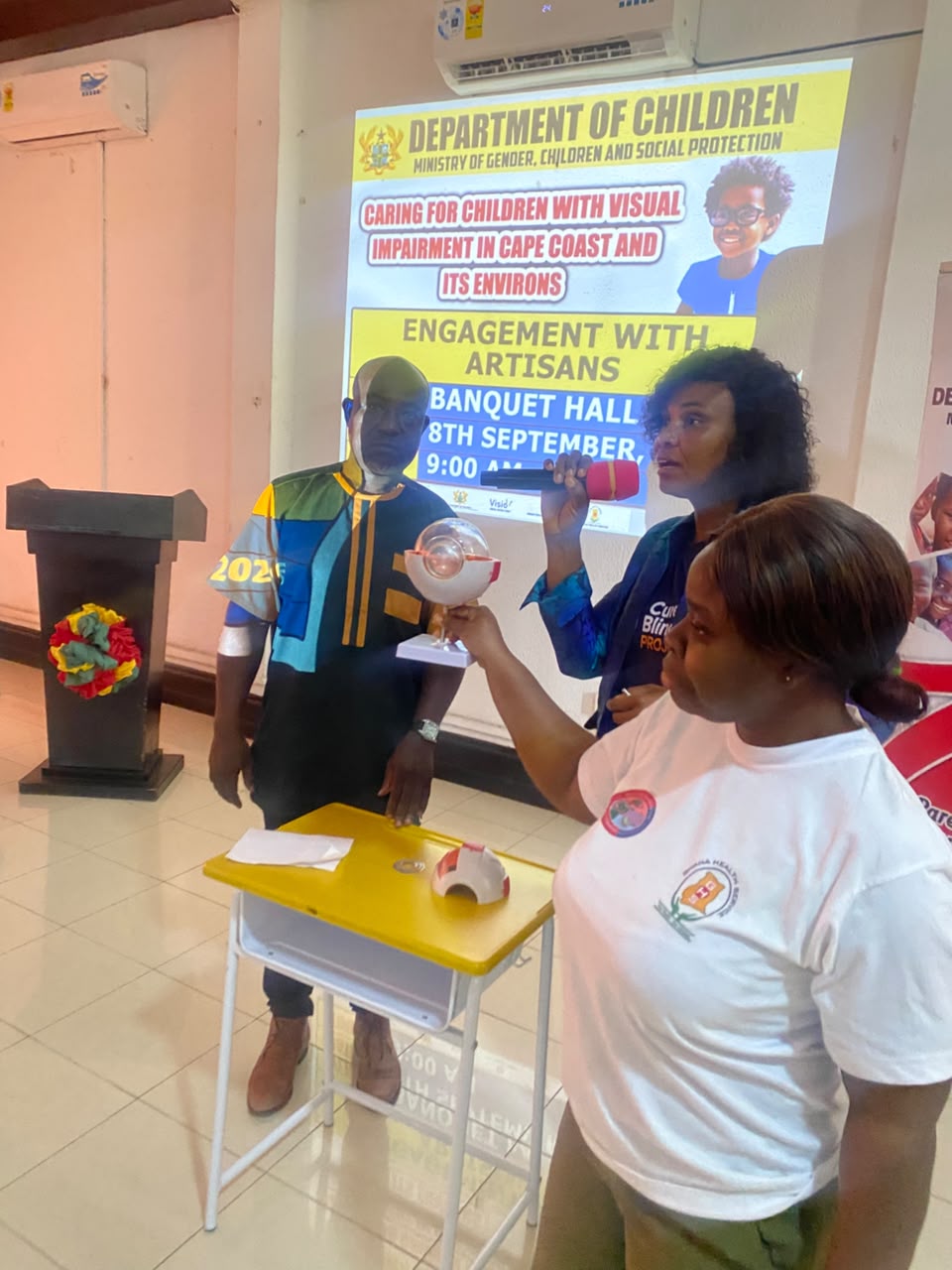
 A child who cannot see well is not cursed, contagious or a victim of witchcraft. That is the starting point of a programme by the Department of Children, under the Ministry of Gender, Children and Social Protection. The programme works to make sure children with visual impairment are identified early, supported at home and in school, and treated with dignity everywhere they go.
The Holistic Development of Children with Visual Impairment (HODVIC) programme is led in Cape Coast by the Cape Coast Metro HODVIC Team. It is delivered with partners Royal Dutch Visio and Presbyterian Health Services.
What the programme aims to do
HODVIC has four main goals:
- Provide adequate support for the holistic development of visually impaired children.
- Ensure their full participation at home, in school and in the community.
- Promote prevention, early detection and proper referral.
- Establish parent support groups.
"Holistic" is the key word. A child's development covers physical growth, communication, emotional wellbeing, thinking skills and social life, not just eyesight. The approach focuses on what a child can do, with the aim of raising a confident, independent and happy child.
Building a network of trained professionals
The programme has trained Department of Children officers, social welfare officers, community health nurses, ophthalmic nurses and special educators. Seven districts were selected for implementation:
- Tano South
- Hohoe Municipal
- North Tongu District
- South Tongu District
- Akwapim North Municipal
- Wa Municipal
- Cape Coast Metro
Activities include community sensitisation, media awareness campaigns, eye screening and assessments, follow-ups, home entry visits, provision of assistive devices and equipment, and parent support groups.
Taking the message to where people are
From 2023 to 2025, the Cape Coast team went to markets, schools, lorry stations, churches and radio studios rather than waiting for families to come to them. Communities and groups reached include:
- Brabedzi
- Dehia
- Pedi Basic School
- Kokokorba All Nations Church
- Anaafu Market
- Kwaprow Basic School
- Tantri Lorry Station
- Alec Jones Basic School, Nkanfoa
- Fisherfolk and market women at Bantsir
- Ebubonko M/A Basic School
- Religious and traditional leaders
- The Ghana Private Road Transport Union (GPRTU)
The team also held radio awareness programmes and a media engagement session.
Experiencing sight loss first-hand
Simulation exercises have become a signature activity. At the sensitisation and eye screening programme at Ebubonko M/A Basic School on 16 December 2025, schoolchildren took part in simulations to understand what it is like to live with visual impairment. At the media engagement at the Regional Coordinating Council (RCC) banquet hall on 17 December, teachers from Cape Deaf guided media personnel through the same kind of exercise. The Department invited the media and community information centre heads from across the region and followed with interviews on the programme.
Training teachers and caregivers
On 19 November 2025, the HODVIC team held a workshop for teachers and day care givers at the Cape Coast banquet hall. The Acting Regional Director, Ms. Ivy-Beauty Amartey, took part in discussions with participants on the holistic development of children with visual impairment. The day included group work and presentations, talks by resource persons, and a simulation exercise led by Cape Deaf teachers. Madam Yvonne Affedzie, the Focal Person from the Department of Social Welfare, spoke about parent support groups and available support services, and the day ended with a question-and-answer session. A few days later, on 25 November 2025, the team took the message to the airwaves with a HODVIC awareness programme on Live FM.
Practical guidance for caregivers and preschool teachers
The workshops are built around a practical guide titled Seeing with the Heart: Nurturing Every Child's Potential, prepared and presented by Abugri Wilson Adiebo and Seth Otoo. It asks caregivers to be bridge builders in three ways:
- A bridge of trust, through love and consistency.
- A bridge of communication, by giving children words for their world.
- A bridge of independence, by teaching "I can do it myself" skills.
Create a "seeing hands, ears and nose" environment
For a blind child, hands, ears and nose are the primary guides, so the guide encourages caregivers to use the power of touch, sound and smell to help the world make sense.
Make routines predictable
- Keep the room consistent. Keep furniture and toys in the same place. A cluttered or ever-changing room is confusing for a blind child.
- Use songs and chants. A "clean-up song" or "hand-washing song" helps children predict what comes next.
- Encourage self-care. Let children try dressing and feeding themselves. It may be messy, but independence is the goal.
Dos and don'ts for talking and working with children
| Instead of… | Try… |
|---|---|
| Leading a child without saying where | "We are going to the table for lunch." |
| Doing everything for the child | Being patient and letting them try: "Can you feel the sleeve? Let's put your arm here." |
| Vague words like "here" or "there" | Being specific: "The cup is on the table to your left." |
| Forgetting the child is always listening | Using rich language to describe feelings, colours and actions. |
Know the early warning signs
Caregivers and teachers are the first line of defence. Signs that a child may have a vision problem include:
- Eyes that wander and don't seem to focus
- Extreme sensitivity to light
- A white or cloudy pupil instead of a black one
- Holding objects very close to the face
- Not making eye contact, or not responding to facial expressions from a distance
Artisans: unexpected allies in child protection
One of the programme's most distinctive ideas is its engagement with artisans, namely hairdressers, dressmakers and carpenters. These workers meet children every day: children who accompany a customer and roam the shop for an hour or two, children brought in for a service, and children playing nearby. As the programme puts it, an artisan's shop can be a community child protection centre.
Artisans are asked to understand visual impairment through three simple concepts: a child is anyone below 18, an impairment is a problem with the eye, and a limitation is not being able to see well. Aids include spectacles, white canes, braille and guides. They are asked to take on four roles.
1. Identifier and counsellor. Observe children in the shop. If something seems wrong, kindly and privately inform the parent. Counsel parents towards medical care, not spiritual explanations, and encourage early screening, love, schooling and vitamin A-rich foods.
2. Protector. Make the shop safe and protect children from mockery and bullying.
- Hairdressers: keep hot water, scissors and loose cords out of reach and off the floor.
- Dressmakers: keep pins and needles in a box, not on chairs or the floor.
- Carpenters: keep tools and nails off walkways.
3. Inclusion champion. Serve every child equally and with dignity. Call children by name, introduce yourself and describe what you are doing. Give clear directions ("the chair is on your left," not "over there"). Offer your elbow, ask permission and be patient.
4. Referral link and advocate. Never treat an eye condition with herbs. Guide the parent to a health centre, eye clinic or CHIPS compound, and on to social welfare, the Ghana Education Service or the District Assembly where needed. Artisans are also encouraged to speak up at association meetings and to teach their apprentices.
Discrimination is not just unkind. It is against the law.
Mocking, refusing service, insulting and excluding a child with a disability all count as discrimination. Ghana's laws protect these children, including Article 17 of the Constitution, the Persons with Disability Act (Act 715) and the Children's Act (Act 560). Artisans are given five rules: equal service, equal language, equal opportunity, stop others from discriminating, and keep confidentiality.
A short list of dos and don'ts sums it up. Do be patient, keep your shop tidy, refer early, include children, and stop discrimination. Don't mock, pity, refuse service, label, gossip or discriminate. The message throughout is that children with visual impairment need support, not pity.
Every small victory counts
The workshop guide ends with a message for everyone who cares for these children: your belief in a child builds their belief in themselves. Celebrate every small victory, remember that patience and love are the most powerful tools, and remember that caregivers are not alone. They are part of a community supporting each other.
Where to get help
If you are worried about a child, or want to report abuse or discrimination, contact:
- Ministry of Gender, Children and Social Protection helpline: 0800 800 800 / 0800 900 900
- Orange Support Centre (for gender-based violence): 0800 111 222
- DOVVSU Police: 055 1000 900
- Short code: 8020
Together for every child.